


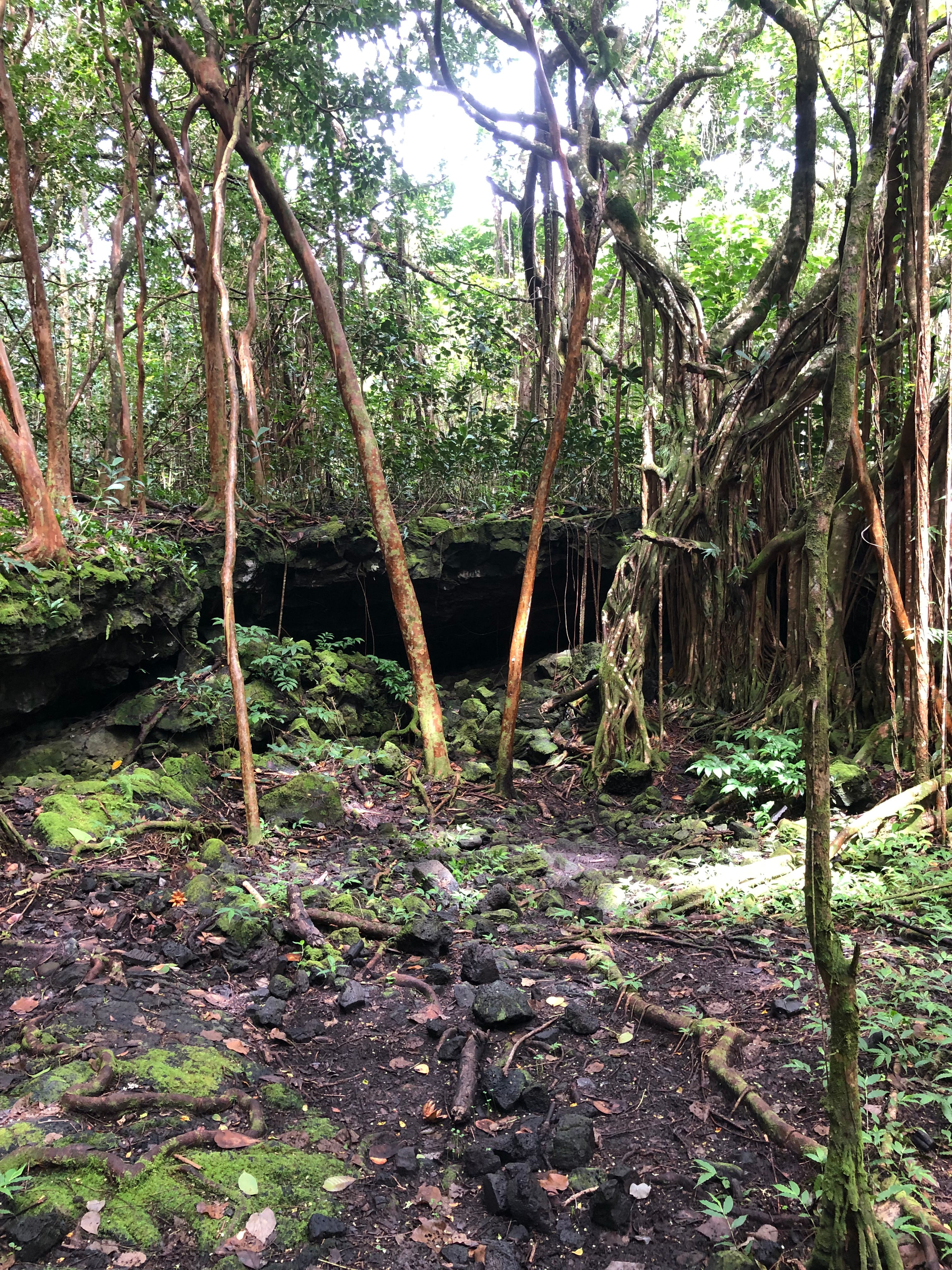
I was walking in the middle of the jungle on a hot muggy day somewhere on the Big Island, in Hawaii. I was a good distance ahead of Justin, leaving him in the dust because I was fuming.
We had traveled to Hawaii to spend time with our friends, and my ulterior motive: convince him that we needed to buy our first home on the island.
We had spent the past year looking for places to buy a home. We had traveled to Arizona, Portland, the Oregon Coast, and even looked in our hometown… but deep down I really wanted to move back to Hawaii and Justin agreed to look at homes there on our visit.
We had made a list of things that were important to us for where we wanted to live, our non-negotiables. Some of those non-negotiables were neighborhoods and cities that had diversity (growing up in a primarily white town, this was important to us for raising a family), amazing coffee shops and restaurants, easy access to nature and hikes, and then things the home needed to have: in budget, a fenced yard, etc.
Everywhere we went to look at homes we used this filter to help us stay focused on what mattered most to us… but without Justin knowing, I had already decided.
We were moving to the Big Island.
So back to me trudging through the jungle, sloshing around on the muddy trail with roots from all the trees popping up, tripping me left and right. I was angry because moments before Justin had told me that he had no intention of living in Hawaii.
Did he give his reasons? Yes.
Were they through the filter we created together? Yes.
Did I care? No. It was ruining MY plan.
I was practically running to get as far away from him as possible because I felt tricked. I felt like he came to the island knowing he had no intention of moving here. I felt bamboozled and pissed at him for not telling me and getting my hopes up.
Then it was like one of the hanging branches of the trees came down and smacked me on the ass.
I realized that the very thing I was mad at Justin for, I had been doing to him.
I hadn't been honest with him either. I was looking at houses in places I didn’t want to actually live with no intention of moving there, and I didn’t tell him.
In that moment my anger at him quickly turned to shame towards myself.
Let’s talk about shame and guilt
We cannot talk about acceptance without acknowledging shame and guilt, because these are the parts of us that are yearning for acceptance the most.
Shame says, “What does this say about me?”
Guilt says, “What did I do?”
Shame is wrapped up in our identity.
Guilt comes up around our behavior.
The reason shame feels so painful is because it doesn’t stop at our actions. It turns our actions into evidence.
Evidence that we’re selfish.
Evidence that we’re manipulative.
Evidence that we’re controlling.
Evidence that we’re not who we thought we were.
And for those of us healing codependency, this can be especially difficult because many of us have built our identity around being thoughtful, caring, self-aware people.
We want to be good partners.
Good friends.
Good daughters.
Good humans.
So when we discover a part of ourselves that doesn’t fit that image, shame comes in and says:
“See? You’re not who you thought you were.”
This healing codependency journey for me has been about realizing that the goal of self-awareness isn’t to find proof that you’re a good person. The whole point of self-awareness is to see yourself clearly.
All parts of yourself.
The parts you’re proud of, including the parts you’re not.
I truly believe that acceptance doesn’t begin when we discover something beautiful about ourselves, I mean it’s easy to accept and love those parts! It begins when we discover something uncomfortable and choose not to look away and run from it.
Eventually the aftershock of shame triggered the guilt. Guilt for the hidden agenda I didn’t share with Justin. For the ways I was withdrawing love and connection as I marched ahead of him in anger as a way to “punish him.” My hopes that this would cause enough discomfort for him that he would change his mind.
I really started to see my own covert manipulative tendencies with a spotlight on them.
But the guilt for these actions also allowed me and opportunity to take responsibility.
I could acknowledge that I hadn’t been honest with Justin.
I could acknowledge that I had become attached to an outcome.
I could acknowledge that I was doing the very thing I was angry at him for doing.
Guilt doesn’t require us to make ourselves the villain, although that is oftentimes what it feels like... guilt can leave us feeling like we are a bad person.
But what if another way we can look at it is by seeing it as an opportunity to tell the truth?
I think that’s one of the biggest struggles people have towards acceptance, because most of us think acceptance means accepting our wounds, our insecurities, or our imperfections.
But often the hardest thing to accept is the shadow aspects of ourselves.
The controlling part of us.
The jealous part of us.
The selfish part of us.
The part that wants things its own way.
Those parts don’t make us bad, though. They just challenge the story we’ve been telling ourselves about who we are.
And I think that healing asks us to make room for all of it, not necessarily so that we can justify or stay stuck in it, but so we can stop abandoning ourselves every time we discover that we’re human.
I wasn’t a bad person standing in that jungle.
I was a human being who had blind spots, just like everyone else.
And the moment I stopped making that realization mean something was wrong with me, I was finally able to learn from it.
So how do we cultivate acceptance?
I thought acceptance was something we arrived at once we had done enough healing. I imagined it as a state where we no longer judged ourselves for our mistakes, our insecurities, or the parts of ourselves we’d rather not have. I thought acceptance would feel peaceful.
But standing in that jungle, realizing I was doing the exact thing I was accusing Justin of doing, was anything but peaceful and the first thing I felt was definitely not acceptance.
It was judgment.
I judged myself for having a hidden agenda. I judged myself for trying to control the outcome. I judged myself for withdrawing love and connection as a way to punish him. And if I’m being honest, there was a part of me that immediately wanted to run from what I was uncovering about myself.
I wanted to explain it away. I wanted to focus on all the reasons my behavior made sense. I wanted to find evidence that I wasn’t actually doing what I had just realized I was doing.
But that’s the thing about acceptance.
Acceptance isn’t the absence of judgment, it’s what we choose to do after the judgment arrives.
I think many of us believe acceptance means approving of everything we find within ourselves, but that’s never been my experience. There are parts of me that I still don’t particularly like. There are behaviors I’ve had to take responsibility for. There are moments I’m not proud of. There are parts of my shadow that continue to make me uncomfortable.
Acceptance doesn’t require us to celebrate those things, it simply asks us to acknowledge them.
To tell the truth.
To resist the urge to immediately turn away from what we’ve discovered.
Have you listened to this recent podcast episode where I discovered a pattern that was causing more harm than good in our relationship?

Because every time we uncover something uncomfortable about ourselves, we arrive at a crossroads. One path leads toward shame and self-rejection. The other leads toward acceptance. The difference isn’t whether we made a mistake or whether we have shadow parts. The difference is whether we decide that what we found means something is wrong with us.
This is why I think acceptance is so closely connected to compassion.
Want to take a moment to feel and cultivate deeper compassion? Explore the shadow work prompts and guided inner child healing meditation here:

When I looked honestly at myself in that moment, I could see my controlling tendencies. I could see how attached I had become to a particular outcome. I could see how I was trying to influence Justin rather than genuinely collaborate with him. Those things were true.
What was not true was the story that followed.
The story that said I was manipulative.
The story that said I was selfish.
The story that said I was a bad partner.
Acceptance required me to separate what I did from who I am.
It required me to acknowledge my behavior without collapsing my entire identity into it and I think this is one of the greatest challenges of healing codependency.
Many of us have spent our lives trying to be “good”. We become so attached to being seen as good that when we inevitably discover a part of ourselves that is controlling, selfish, jealous, dishonest, or afraid, it feels threatening to our entire identity.
But what if acceptance is recognizing that both things can be true?
What if I can be a loving partner and still have controlling tendencies?
What if I can be a caring person and still have selfish moments?
What if I can be deeply committed to growth and still have blind spots?
The older I get, the more I think acceptance has less to do with liking everything we find within ourselves and more to do with being willing to stay present with it.
To stop running from our humanity.
To stop making our mistakes mean we are unworthy.
To stop abandoning ourselves every time we discover another imperfect part.
Because the truth is, I wasn’t a bad person standing in that jungle. I was a human being having a very human moment. And the moment I stopped making that realization mean something was wrong with me, I was able to learn from it.
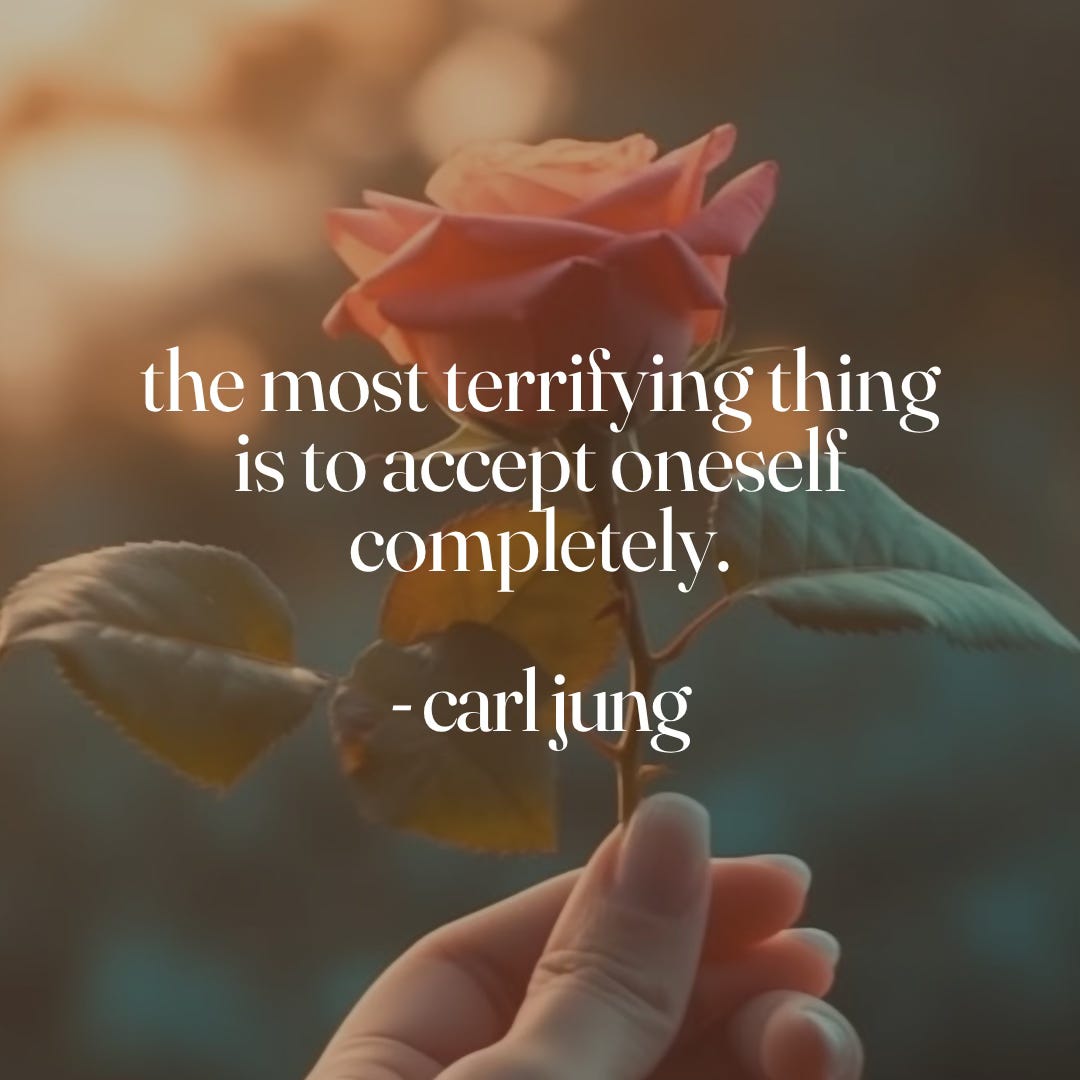
Maybe that’s what Jung meant when he said that accepting ourselves fully is terrifying.
Not because we are afraid of our wounds, but because we are afraid of our wholeness.
We are afraid of discovering that we contain all of it: the beautiful parts, the messy parts, the loving parts, and the shadow parts too.
And acceptance asks us to make room for every single one.
If this resonated, please like and share it with others. As always, thank you for being here and witnessing me in my soul mission of healing codependency, the mother wound, and helping us all learn how to come home to ourselves.
And if you’re ready to deepen this work, I’d love to have you inside the Codependency Alchemy membership.
Every month, we explore the patterns that keep us disconnected from ourselves and the practices that help us cultivate more self-awareness, self-trust, and self-acceptance. Through guided practices, shadow work, live calls, and community support, you’ll learn how to stay present with yourself through life’s challenges instead of abandoning yourself in them.
You can click the link below to upgrade and join us.
